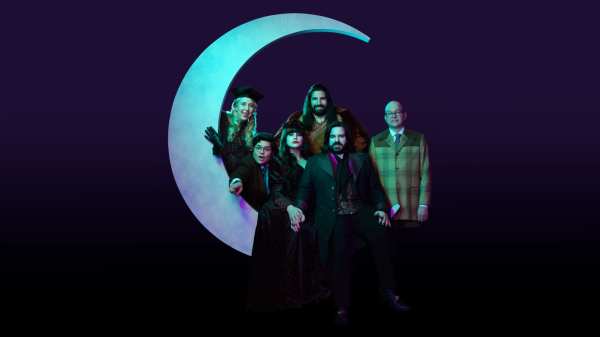
It’s time to fly one last time with Nandor, Nadja, and Laszlo…but not you Guillermo!
The sexy folks over at Gizmodo have let us know that FX has locked in Monday, October 21st for the return of everyone’s favorite bloodsucking roommates.
The series will likely go out with a bang, as the cast recently showed up at Comic-Con to give the lowdown on what we can expect from he show’s sixth and final season. Will we get awesome cameos? Will the documentary crew ever be seen? And, most importantly, will Jackie Daytona ever make another appearance? None of us mere mortals know for sure. For now, be patient, file down your teeth, and pop over to Gizmodo to check out the original article.
The “Friday the 13th” folks were a little late in finding a tie-in rock star for their franchise. The good news is that they snagged the perfect one.
For the kids who didn’t have MTV, NBC’s “Friday Night Videos” was possibly your singular lifeline to music. Sure, TBS’s “Night Tracks” was far superior, and USA Network’s one-two punch of “Night Flight” and “Radio 1990” was working on a whole other level, but “Friday Night Videos” gave you a close enough peek at the latest Billboard sounds that you wouldn’t be made fun of at school on Monday morning.
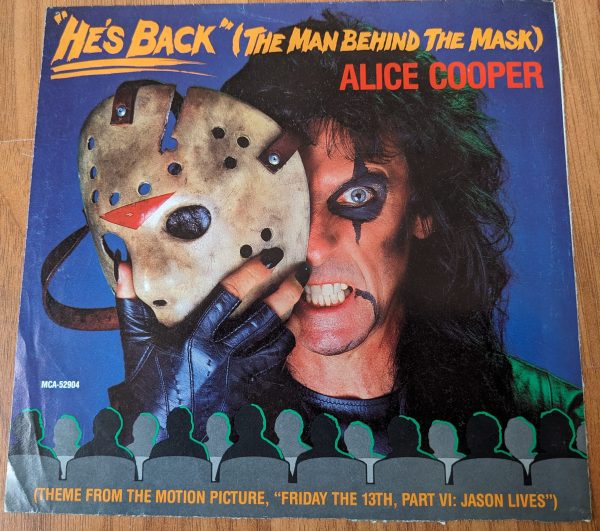
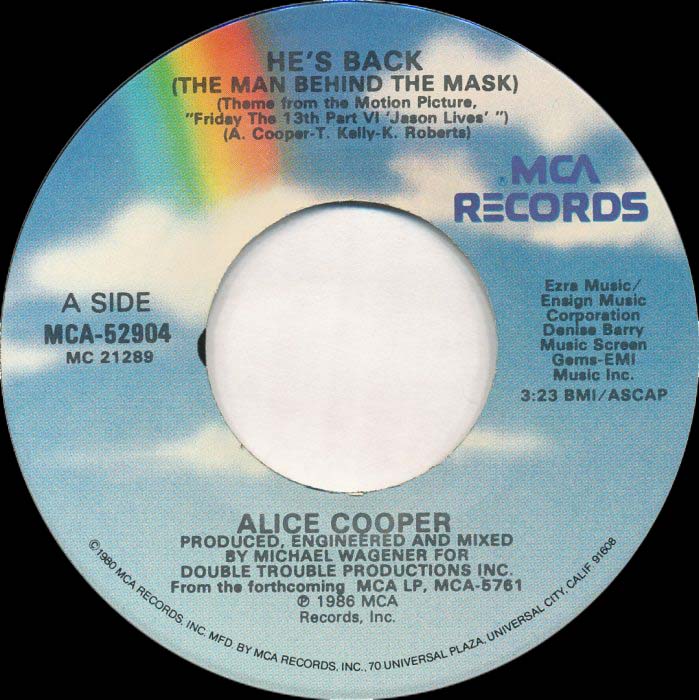
“Friday Night Videos” could be counted on for one thing–the most superficial choices when it came to their programming. That’s not a bad thing–you’d be nuts to show some ‘bubbling under’ college hit in favor of something like Janet Jackson or John Cougary Mellonballs–but you can imagine my surprise when Alice Cooper popped up one night with the theme to the latest Jason Voorhees adventure, FRIDAY THE 13th PART VI: JASON LIVES.
Cooper’s career was kind of in the shitter by the mid-80s after a hard left turn into new wave and an even harder turn into drugs and alcohol. Though it was only a moderate success, the slick synth metal and hummable chorus of “He’s Back” was Cooper’s first step back up the rock ladder. By the end of the 80s he was once again in the top ten, in heavy rotation on MTV for the first time, and had even appeared in John Carpenter’s PRINCE OF DARKNESS (1987).
In retrospect, the sixth FRIDAY THE 13th is generally regarded as one of the more entertaining and humorous sequels. Cooper, having gained the moniker of The Godfather of Shock Rock from his outrageous, horror-drenched stage shows featuring guillotines, electric chairs, and gallons of fake blood, ended up being the perfect match for a goofy mid-80s entry of our favorite campy film series.
Though that fateful night on “Friday Night Videos” was the only time I ever saw “He’s Back” broadcast, the magic of YouTube has made sure it’s no longer a rarity. Indulge yourself now!
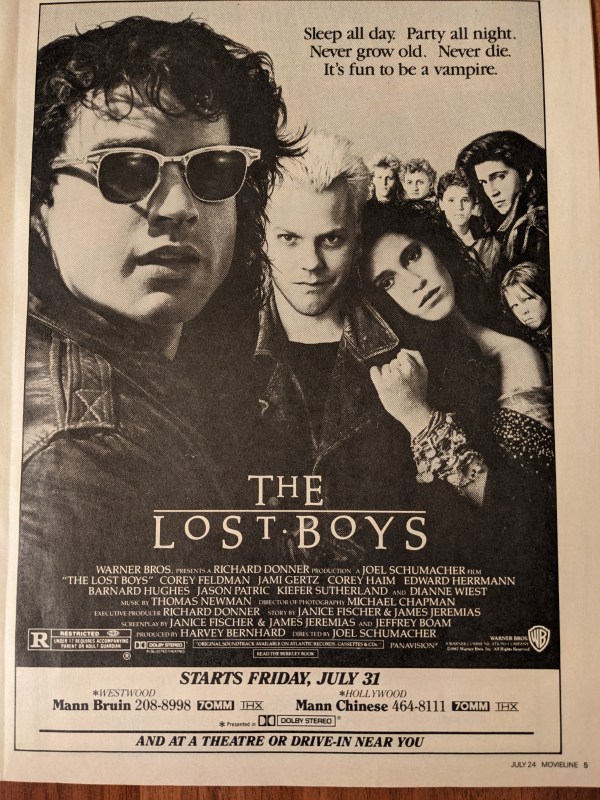
On this day back in 1987, Joel Schumacher,’s THE LOST BOYS swooped into theaters to raise some hell.
Though it wasn’t a huge hit, and some critics dismissed it as ‘vampires for the MTV generation’, the film has since been widely reappraised as one of the tightest examples of the slick vampire comeback of the 80s that also featured FRIGHT NIGHT (1985), VAMP (1986), and NEAR DARK (1987).
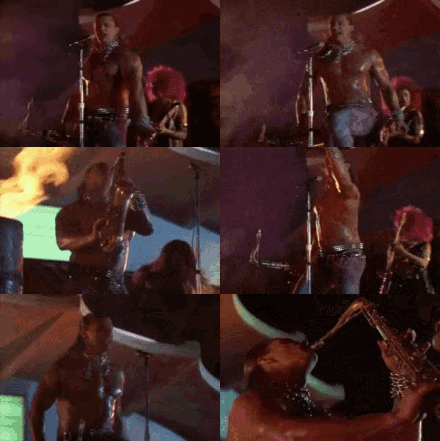
And no look back at THE LOST BOYS would be complete without mentioning Timmy Cappello. When he popped up in the film, I remember shouting, “Hey, there’s Tina Turner’s saxophonist!” Man, my dude was ripped back in the day.
I thought it would be a good time to congratulate all the folks involved with LONGLEGS, as they jumped over the $50 million mark last week after only 12 days in theaters. Damn, way to go, guys! I guess this has taught us one thing–never underestimate the power of Nicolas Cage.
With no concrete streaming date announced yet, it should bring in another few million before getting lost in the latest onslaught of pre-Labor Day family blockbusters, including (deep breath) DESPICABLE ME 4, INSIDE OUT 2, THE GARFIELD MOVIE, a re-re-re-release of THE LION KING (seriously?), and SAVING BIKINI BOTTOM: THE SANDY CHEEKS MOVIE (okay, that one does sound pretty bitchin’, actually).
Don’t worry, fright fans, Halloween is only three months away. Our time is nigh!
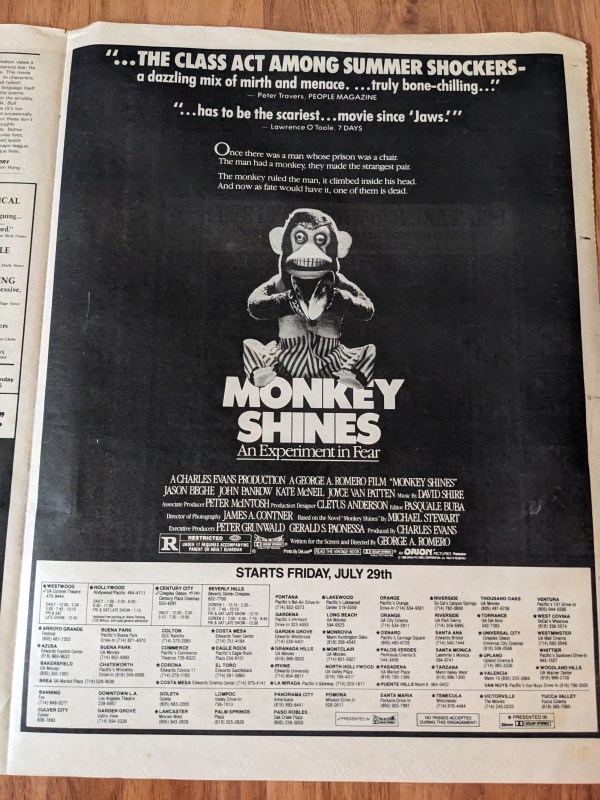
A long 36 years ago today, George A. Romero’s MONKEY SHINES debuted. Here’s a full page advert I saved from all those years ago.
Despite some solid marketing of the film by Orion, it ultimately floundered at the box office. Even Romero’s then-wife, Christine, went on record saying it was the “toughest shoot” the Romero camp had encountered up to that point. Was it too idiosyncratic for audiences? Possibly. I’m willing to bet it was the title that killed it, though–it was a cute pun, but ultimately a bad choice for an adult thriller.
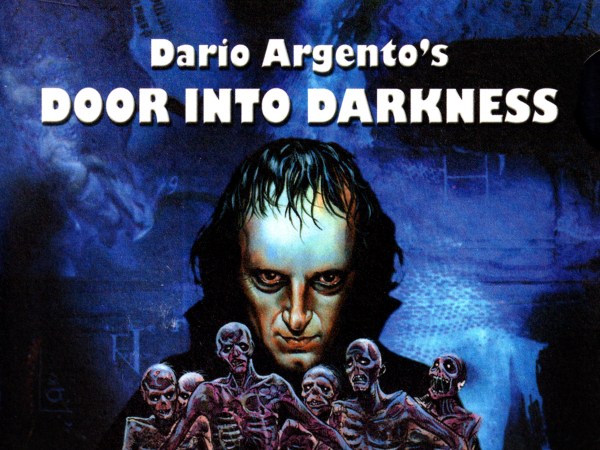
Somehow, the news of Dario Argento having a television show in the early 1970s fell outside the range of my horror radar. I may have heard about it many years ago in passing, but availability for the series here in the US was scant at best until after the turn of the 21st century.
DOOR INTO DARKNESS (or “La Porta sul Buio” for you purists) was a four-episode lark produced by Argetno for RAI – Radiotelevisione Italiana back in September 1973. Chronologically, it filled the horror maestro’s genre sabbatical that fell between FOUR FLIES ON GREY VELVET (1971) and his magnum opus, DEEP RED (1975).
The show aligned perfectly with Argento’s giallo sensibilities but, because of the limitations put on small-screen violence, the show leaned heavier on crime drama aspects. That’s not to say the show wasn’t suspenseful, as evidenced by “The Tram”, the first episode filmed (and second broadcast), which sports an efficient, nail-biting conclusion to a murder mystery set on the titular form of public transport.
However, the series’ premier offering, “The Neighbor”, injects an even higher dose of terror. The audience willingly tags along as we watch a young couple slowly realize their new neighbor is a murderer. Sure, there are egregious mistakes made by stalker and victims alike–we gotta wrap this up in under an hour, folks!–but it all leads to a nicely understated ending that seemed perfect for a bite-sized, prime-time giallo. Naturally, Argento’s fingerprints are all over the production, but this episode was actually helmed by Luigi Cozzi, fellow countryman responsible for the noted ALIEN rip CONTAMINATION (1980), and who also worked on later Argento flicks such as PHENOMENA, TWO EVIL EYES, and THE STENDHAL SYNDROME. Cozzi turns in some of his most disciplined writing and directorial work here, anchored by a windy seaside setting and serviceable performances all around.
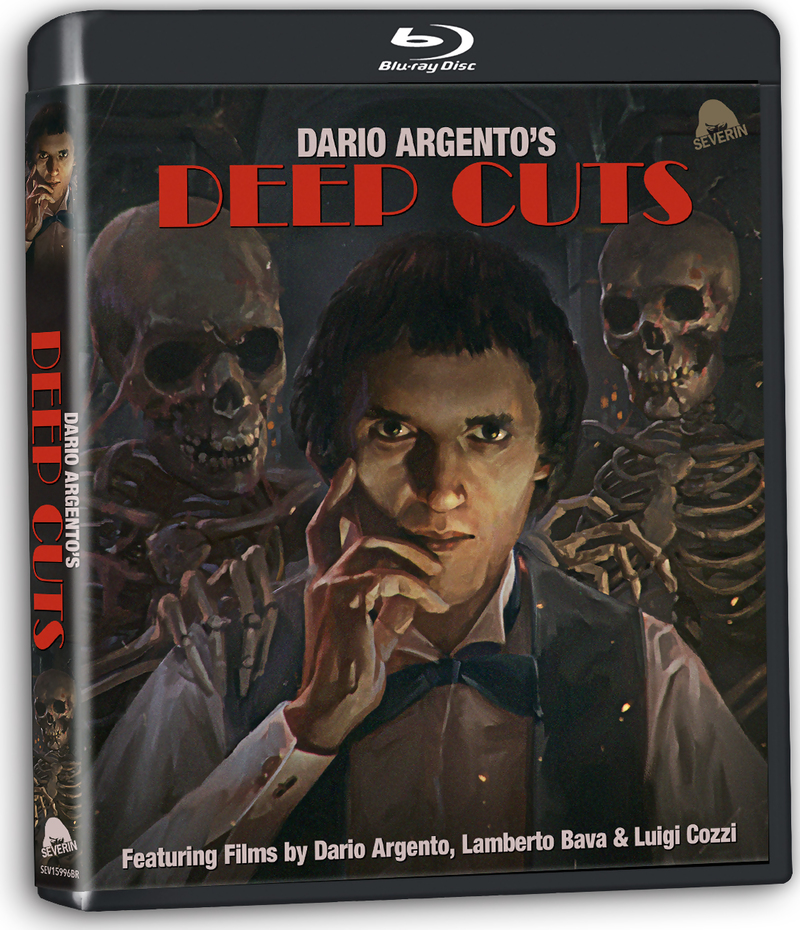
After languishing in the grey-market shadows for years, MYA Communications issued a DVD release for DOOR INTO DARKNESS back in 2009. However, Severin Films is queuing up to include the entire series as part of its DARIO ARGENTO’S DEEP CUTS release slated for the second half of 2024. If you’re an Argento completist, or just want to dive a little deeper into the giallo pool, this ain’t a bad place to start.
I went back and caught the fully uncut version of this recently. Since I originally didn’t take to it the way I had with Stuart Gordon’s other bangers such as RE-ANIMATOR (1985), DOLLS (1987), THE PIT AND THE PENDULUM (1991), and DAGON (2001), I’m pleased to report it’s growing on me with age. I’ll watch damn near anything with Ken Foree, so that helps, too.
If you’re going to infringe on someone’s copyright, go big or go home.
Horror is one of art’s oldest genres. It also happens to be one of the most lucrative ones. There’s an incredibly simple reason for this: For every original success story within the genre, there are a hundred copycats just waiting to dig their claws into the coattails of their inspiration and ride their way to a quick buck.
Though it’s been largely forgotten in the wake of a newer crop of devilish thrillers, BEYOND THE DOOR (also known as THE DEVIL WITHIN HER internationally) will ultimately endure for a number of whacky reasons. Its original surprise success was very likely the reason for its notoriety–namely that it ended up being one of the only films you’ll ever see that had its ass sued off by the rights owners of the “inspiring” source material.
Warner Bros. took one look at the head-turning, vomit-blasting, profanity-filled possession romp and immediately phoned their attorneys. Sure, they had a point (and won the case, to boot), but let’s look at the two real reasons BEYOND THE DOOR made more than 20 times its budget in the US alone.
First, let’s talk marketing. You gotta admit director Ovidio G. Assonitis worked fast, getting his “tribute” into theaters less than a year after THE EXORCIST first exploded onto the horror scene. Even more admirable were its original TV spots. These should have won some kind of early Clio Award for destroying the minds of an entire generation of American children. Just imagine the shitstorm this created when it popped up in the middle of something like “The Waltons”.
Next, we’ve got to take a peek at the casting. Just a few years earlier, Emmy Award-winner Juliet Mills was playing a proper, yet keenly intuitive English nanny on TV’s “Nanny and the Professor”. Here, both her head and her career take a 180-degree turn. When she’s not having violent mood swings and eating discarded bananas, Mills is levitating and doing kooky things with her eyes (trust me, you’ll know it when you see it). Talk about going against type!
But if we’re going to talk about casting, there’s no way we can ignore Mills’ two kids, who are hands-down the best thing in the film. These tots are barely out of kindergarten, but they curse like they’re already enrolled in the Samuel L. Jackson School of Technology. Also, the film’s seven writers pulled their collective genius to give these little semen demons arguably the most entertaining dialogue of the mid-70s, which, in hindsight, might be more normal than you might think if you have to endure a devil-possessed mother. The line “Man, if you don’t quit crying, you’re gonna have a real bad trip!” is so righteous, I hang out with unstable people just so I can work that ripper in conversation.
To celebrate a half-century of all this nutty bullshittery, go treat yourself to the Code Red or Arrow Films release of BEYOND THE DOOR on Blu-ray. Why? Because it not only contains the original cut of the film, but also the extended European versionsuitable for all of you who have absolutely no shame (and that’s basically 93% of the people reading this article–bless all of you and your perverted little hearts).
Here’s something amusing to get your Monday started off right.
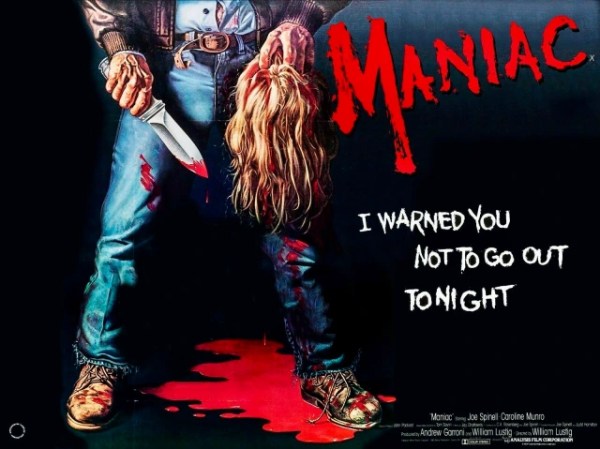
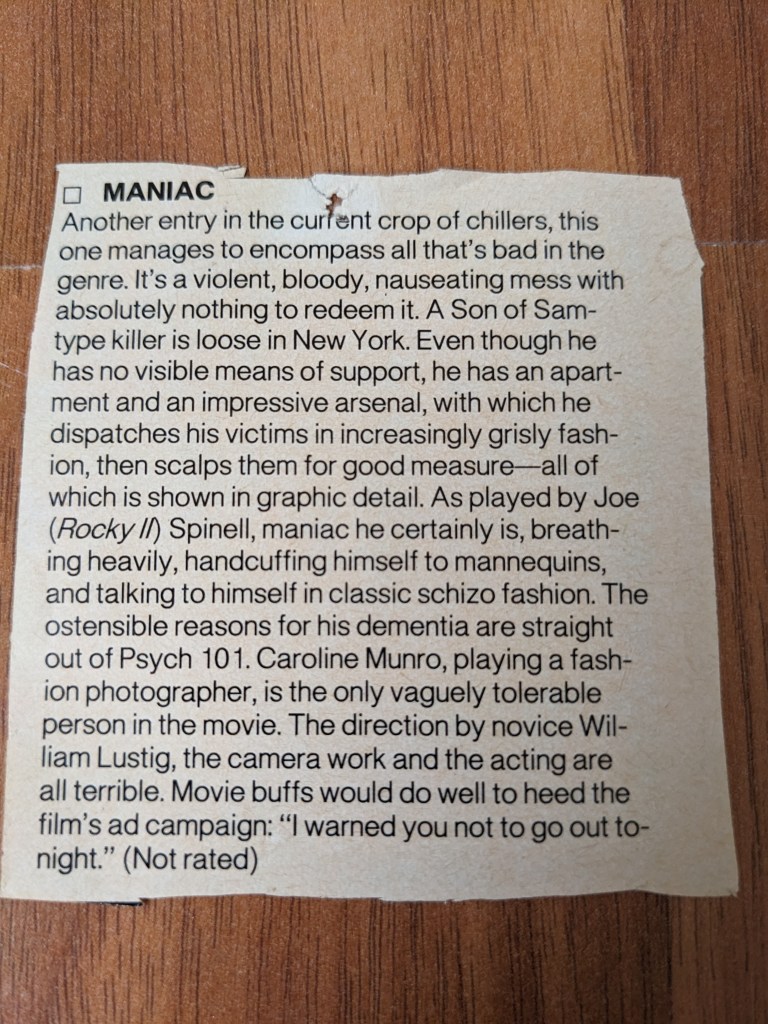
If I’m remembering correctly, this is a review of William Lustig’s grindhouse classic, MANIAC, taken from People Magazine back in early 1981. We’re going back over 40 years here, so forgive me if I’m wrong.
The poor reviewer who was saddled with this assignment didn’t seem to find the entertainment value in scalping people and then letting your mannequins take first crack at modeling them. Oh well, you can’t win ’em all. As Alan Thicke once sang, “It takes different strokes to move the world, yes it does”.

 UNBOUND HORROR BLOG